
SERVER PLUS INSIGHTS
What Is L3/L4 Anti-DDoS? BGP Scrubbing, Anycast, and Clean Traffic Delivery Explained
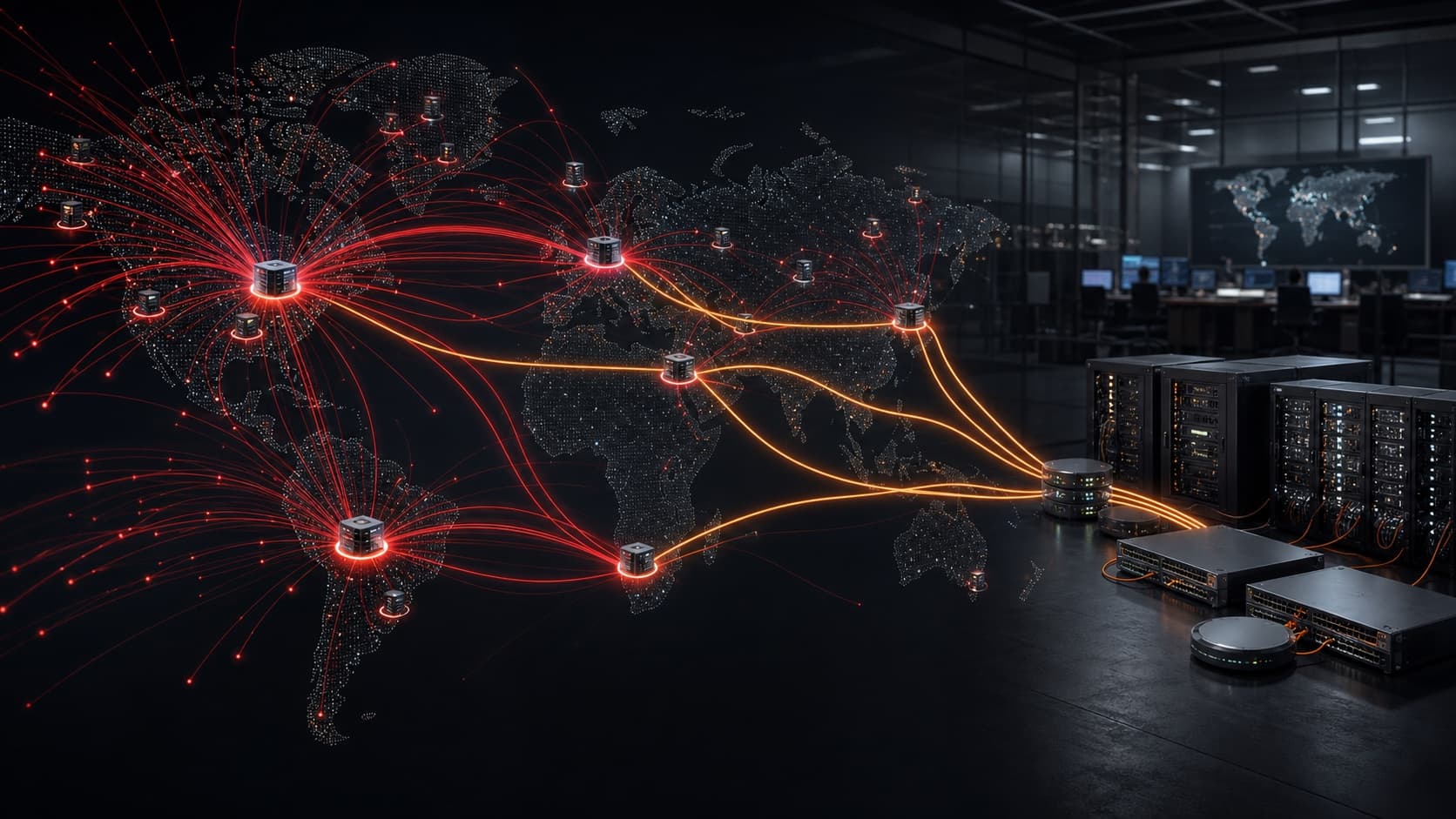
An enterprise service outage does not always mean that a server or firewall has failed. When a UDP flood, SYN flood, or reflection-amplification attack saturates the upstream circuit first, legitimate users cannot connect even if every device inside the data center remains healthy. L3/L4 Anti-DDoS addresses this problem before attack traffic reaches the enterprise edge: BGP directs the protected prefix into a distributed scrubbing network, abnormal packets are removed, and clean traffic is delivered back to the enterprise.
2026-08-30 · Server Plus
A practical explanation of how L3/L4 Anti-DDoS uses BGP, global Anycast, network-layer traffic scrubbing, and clean traffic delivery to mitigate UDP floods, SYN floods, reflection attacks, and upstream congestion.
L3/L4 DDoS and L7 Attacks Are Different Problems
L3/L4 Anti-DDoS protects the network and transport layers. It evaluates IP, protocol, source distribution, packet rate, connection state, and TCP or UDP behavior. Common vectors include UDP floods, ICMP floods, SYN floods, SYN-ACK reflection, DNS floods, and reflection-amplification attacks. Their objective is usually to exhaust circuit capacity or the packet and connection resources of routers, firewalls, load balancers, and servers.
L7 attacks target HTTP, HTTPS, login, search, API, or application logic. They may use little bandwidth while exhausting back-end CPU, databases, or worker threads. L3/L4 Anti-DDoS does not replace CDN, WAF, rate limiting, bot management, or application security. Likewise, a WAF alone cannot restore an upstream Internet circuit that has already been saturated.
- L3: IP, ICMP, routing, and packet-level anomalies
- L4: TCP, UDP, connection-state, and port attacks
- L7: HTTP, API, and application resource exhaustion
- Complete protection assigns network and application layers separate responsibilities
Why an Enterprise Firewall Cannot Stop a Large Volumetric Attack Alone
Deploying a high-end FortiGate, Palo Alto, Cisco, Juniper, or another firewall does not create upstream scrubbing capacity. A firewall sits behind the Internet circuit. If an enterprise has a 1 Gbps circuit and an attack produces tens or hundreds of gigabits upstream, the circuit congests before the firewall can receive and process legitimate traffic.
Even without full circuit saturation, large numbers of half-open TCP connections, out-of-state packets, or high-PPS small packets can consume session-table capacity, CPU, or interface packet-processing resources. The enterprise firewall remains essential for access policy, VPN, and application control; large L3/L4 attacks require mitigation upstream on a network with sufficient capacity.
The End-to-End L3/L4 Anti-DDoS Traffic Path
A working architecture does more than block attacks. It must continue delivering legitimate packets to the origin. The path normally includes the following stages:
- BGP onboarding: the scrubbing network announces the protected IPv4 prefix so inbound traffic reaches the protection platform first
- Anycast ingestion: distributed network edges receive traffic from different regions instead of concentrating it in one scrubbing center
- Detection and mitigation: packet characteristics, rate, state, and normal baselines identify abnormal UDP, TCP, and ICMP behavior
- Clean traffic delivery: after attack packets are removed, legitimate traffic returns through GRE, IPsec, an interconnect, or a local access circuit
- Return-path design: Direct Server Return, symmetric return, or policy routing prevents asymmetric-routing failures
Why BGP and Anycast Matter
BGP determines how the Internet reaches an enterprise public prefix. When the protection platform announces that prefix, global inbound traffic first enters the scrubbing network. Anycast distributes the same service entry point across multiple network locations, and routing conditions determine where traffic enters. Attack load can therefore be absorbed closer to its sources instead of converging on the enterprise data center.
A /24 is generally the smallest IPv4 route broadly accepted across the global Internet. Organizations onboarding customer-owned space must confirm prefix length, ASN, routing authorization, and existing upstream policies. A single IP or a subnet smaller than /24 cannot be assumed to support the same BGP model; provider-assigned IPs, reverse proxying, NAT, or another delivery architecture may be required.
How Clean Traffic Returns to the Enterprise
After mitigation, the service still needs a controlled and observable delivery path. Common options include GRE, IPsec, data-center cross-connects, private network interconnects, and carrier last-mile circuits. GRE is simpler but does not encrypt traffic. IPsec provides encryption and source authentication but introduces IKE, key, MTU, anti-replay, and device-compatibility considerations. A data-center interconnect can provide more predictable capacity and latency but adds port and cross-connect costs.
An enterprise design should not depend on one tunnel or one BGP session. Dual routers, multiple sessions, separate delivery locations, tunnel health checks, and route priorities determine whether traffic survives a path failure. This is why procurement must ask not only how many gigabits can be mitigated, but also how clean traffic will be delivered.
Mitigation Policy Is Not a Set-and-Forget Configuration
Automated systems use managed rules, traffic characteristics, rates, and normal baselines. During onboarding, teams should observe normal traffic, busy periods, protocol distribution, packet sizes, and legitimate high-volume events before setting sensitivity and exceptions. A policy that is too loose may pass attack traffic; one that is too strict may affect promotions, software releases, backup synchronization, or legitimate connection bursts.
An operational service should report event timing, attack vectors, peak bps, peak pps, source distribution, targeted prefixes, and destination ports. These data points help validate mitigation, review capacity, tune policy, and find bottlenecks that remain inside the enterprise network.
Which Organizations Need L3/L4 Anti-DDoS Most?
Any organization operating public IP services should assess network-layer protection when downtime causes lost revenue, customer complaints, failed transactions, or operational disruption. Common examples include gaming platforms, IDC and VPS providers, colocation services, financial APIs, VPNs, DNS, SaaS, cross-border commerce, streaming, ticketing, and public TCP or UDP services.
Assessment starts with ASN, prefixes, normal and peak legitimate traffic, packet rate, protocols, service locations, tolerated downtime, and existing upstreams. Server Plus Anti-DDoS uses a Cloudflare Magic Transit protection architecture with BGP prefix protection, global Anycast mitigation, and local clean-traffic delivery planning in Taiwan.
Technical Checklist Before Onboarding
Complete these checks before signing and scheduling cutover so routing, MTU, or delivery capacity issues are found before production.
- Confirm ASN, prefix ownership, LOA, and the smallest route that can be announced
- Measure average, 95th-percentile, peak bps, and peak pps
- Define inbound scrubbing, return routing, and whether symmetric traffic is required
- Confirm tunnel, BGP session, router, and delivery-port redundancy
- Test MTU, MSS, fragmentation, health checks, and failover
- Define alert contacts, severity, reports, and 24×7 escalation
- Review SLA measurement, exclusions, and service-credit terms
- Plan production cutover, rollback, and attack simulation
FAQ
Can L3/L4 Anti-DDoS replace a WAF?
No. L3/L4 protection handles IP, TCP, UDP, ICMP, and network traffic. A WAF handles HTTP, HTTPS, and web-application attacks. Public websites commonly need both layers.
Do we still need Anti-DDoS if we have a high-end firewall?
Yes when upstream saturation is a risk. An on-premises firewall cannot restore bandwidth that has already been consumed before traffic reaches it.
Why does customer-owned IPv4 usually require at least a /24?
A /24 is generally the smallest IPv4 BGP route broadly accepted on the global Internet. Smaller networks require provider IPs, proxying, or another delivery model.
Does Anycast increase latency?
Latency depends on routing, ingress location, mitigation processing, and clean-traffic delivery. Test major user regions, origin paths, and failover rather than judging Anycast by name alone.
Can protection be onboarded during an active attack?
Urgent assessment can begin with the ASN, prefix, current traffic, service location, and routing authority. Actual activation time still depends on authorization, BGP, circuits, and router readiness.