
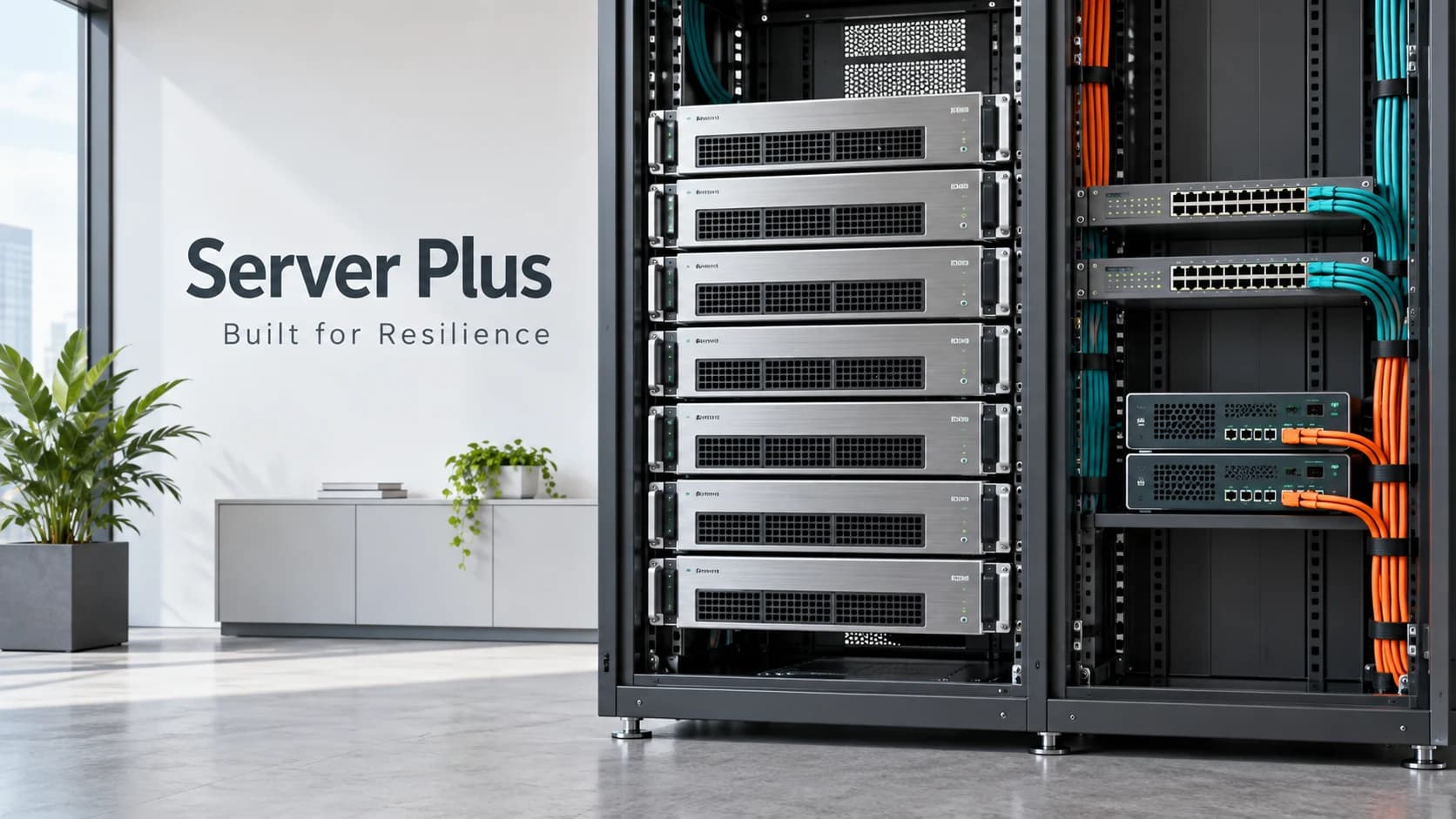
SERVER PLUS INSIGHTS
Beyond Buying Servers: Server Plus Helps Businesses Allocate IT Budgets to Resilience
Server procurement often focuses on processor generation, core count and unit price. For businesses running ERP, databases, virtualization and internal services, a more important question is whether critical services can be taken over and recovered when equipment fails. Server Plus believes enterprise infrastructure should be assessed through workloads, redundancy, maintenance conditions and total cost of ownership, not simply equipment age or individual specifications. Tested refurbished servers, paired with appropriate network and security equipment, allow limited budgets to cover more nodes, spares and recovery capability.
2026-09-22 · Server Plus
Combining refurbished enterprise equipment with compute, network and security planning helps limited budgets support more complete high-availability deployments. A seven-node HPE DL380 Gen10 case illustrates procurement beyond individual specifications.
From Individual Purchases to Infrastructure Planning
The cost of new enterprise servers increases with processor, memory and storage configurations and manufacturer service terms. When most of a budget is concentrated in a small number of high-specification machines, redundant switches, firewalls, storage and spares can receive insufficient investment.
Even a server with adequate performance can remain a single point of failure if no other equipment can take over its workload.
Server Plus first identifies the services to support, acceptable downtime and future expansion requirements, then selects equipment and configurations. Savings from refurbished equipment can fund node redundancy, network backup paths, maintenance resources and deployment validation rather than merely reducing the unit price.
Seven-Node Deployment: More Than 5TB of Memory
In an enterprise deployment, Server Plus used seven refurbished HPE ProLiant DL380 Gen10 servers to plan a multi-node high-availability environment.
Together, the seven servers provide 5,376GB of memory, more than 5TB, as the compute foundation for enterprise virtualization and applications.
The network layer uses Cisco Nexus N9K-C93180YC switches with vPC for switch and link redundancy. Fortinet FortiGate FG-200G HA at the security boundary incorporates firewall redundancy into the overall design.
The purpose is not simply to increase the number of devices, but to plan for failures across compute, networking and firewalls. Each server has the following configuration:
- Processors: 2 × Intel Xeon Gold 6248
- Memory: 768GB
- Storage: 8 × 1.92TB enterprise SSDs
High Availability Requires Failure Validation, Not Just More Devices
Purchasing two devices does not, by itself, complete a high-availability deployment.
After a server goes offline, do the remaining nodes have sufficient resources? Do storage and cluster quorum still operate correctly? Can traffic take another path when a switch or link fails? After firewall failover, do connection state, routing and applications behave as expected? These questions require design and testing.
Server Plus emphasizes that high availability aims to reduce interruption risk and recovery time; it does not promise uninterrupted operation through every failure. Actual recovery depends on the virtualization platform, storage architecture, network settings and application design, and should be validated within planned maintenance windows.
Before delivery, hardware health, memory, disks, network interfaces, firmware and compatibility must also be checked. Functional testing and extended stress testing help identify problems before production deployment.
Extending from Servers to Enterprise Networks and Cloud Connectivity
Stable enterprise services depend on more than servers.
Switches, firewalls, static IPs, BGP, external bandwidth and DDoS protection can all affect service availability. When businesses adopt AWS, Microsoft Azure or Google Cloud, connections between offices, data centers and cloud environments also require coordinated planning.
Server Plus therefore offers refurbished enterprise servers, network and security equipment, Office Connect, Anti-DDoS, Taiwan VPS and global cloud and data center interconnection, helping businesses extend procurement into complete infrastructure deployment.
Refurbished Equipment Means Allocating to Requirements, Not Lowering Standards
Refurbished equipment is not appropriate for every project. Businesses requiring the latest compute capabilities, specific manufacturer service commitments or compliance with procurement rules should still select qualifying new equipment.
For many ERP, virtualization, backup and internal services, however, the newest hardware generation is not the only option. If an existing-generation platform meets the workload, spending on redundancy, spares and operational capability may align better with business needs than simply buying a newer individual machine.
Server Plus aims to help businesses acquire more than equipment with suitable specifications: a reasonably configured, integrable and validated infrastructure.
About Server Plus
Server Plus is a Taiwan-based supplier of refurbished enterprise equipment and IT infrastructure services. It provides Dell and HPE servers, Cisco, Juniper, Arista and Fortinet networking and security equipment, plus enterprise network access, Anti-DDoS, Taiwan VPS and global cloud and data center interconnection.
For enterprise procurement and deployment enquiries, contact Server Plus sales. Telephone: 02-8521-2630.
FAQ
Are refurbished servers suitable for every business?
No. Selection should consider workloads, software compatibility, manufacturer support requirements and procurement rules. New equipment retains its value where the latest hardware or specific manufacturer services are mandatory.
Does buying two devices establish high availability?
Device count alone is insufficient. Remaining capacity, storage, cluster quorum, network and application recovery behavior must be verified in maintenance windows. High availability does not mean zero interruption under every failure.
What information is needed to plan HA?
Start with key applications, current resource usage, acceptable downtime, existing storage and networking, expansion requirements and budget. These form the basis for equipment selection and redundancy planning.